SA8000:2026 Standard for Decent Work
The SA8000 Standard is the world’s leading social certification program. The SA8000 Standard and Certification System provide a framework for organizations of all types, in any industry, and in any country to conduct business in a way that is fair and decent for workers and to demonstrate their adherence to the highest social standards. Created by SAI as the first credible social certification, it has led the industry since 1997.
↳ https://sa-intl.org/programs/sa8000/
Social Accountability International (SAI), founded in 1997, is a global non-governmental organization advancing human rights at work. SAI is a US-based charitable 501(C)(3) organization. SAI empowers workers and managers at all levels of businesses and supply chains, using its multi-industry SA8000® Standard, as well as Social Fingerprint®, TenSquared, and other training and capacity-building programs.
↳ https://sa-intl.org/about/
SAI updated SA8000® Standard for 2026 and published SA8000:2026 Standard on January 1, 2026. The Standard can be downloaded from https://sa-intl.org/resources/sa8000-standard/#download. The English version hosted by MGMAemp is at https://docs.mgmaemp.com/public/SA8000-2026-Standard-20260511dl.pdf.
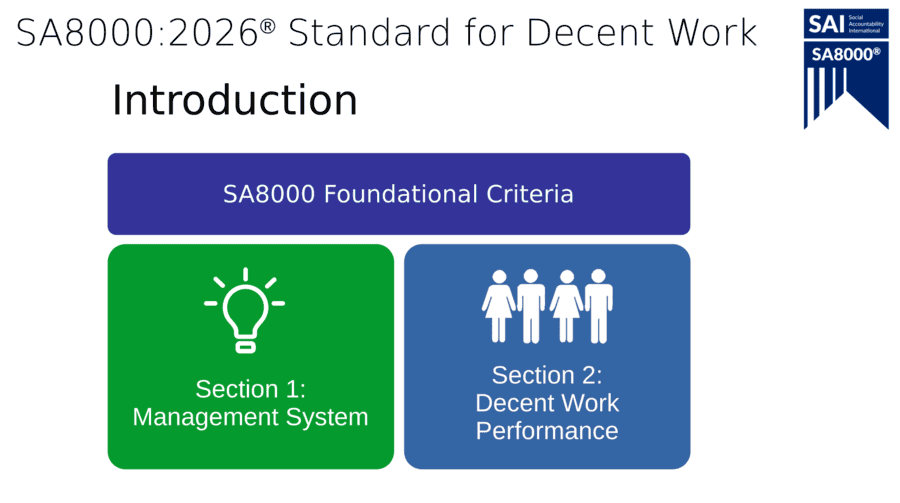
SA8000:2026 Standard is comprises three major parts and one appendix:
- Foundational Criteria
- Section 1. Management Systems: Governance and Due Diligence
- Section 2: Decent Work Principles and Performance Criteria, and
- Appendix A. Definitions
1. Foundational Criteria
Foundational expectations for all organization in meeting this Standard.
- F1 — shall respect the principles of the Standard and the international documents it draws on, and seek to continually improve
- F2 — shall ensure performance at minimum meets:
- legal and regulatory requirements relevant to this Standard
- collective bargaining agreements, and
- other requirements relevant to this Standard to which the organization subscribes
- F3 — shall apply the criteria most beneficial to personnel where legal and/or regulatory requirements differ from this Standard
- F4 — shall identify, prevent, mitigate, and remediate the risks to personnel, to the extent permitted by law where legal and/or regulatory requirements contradict this Standard
- F5 — shall establish, implement, maintain, and continually improve a management system grounded in leadership commitment and worker and stakeholder involvement.
2. Section 1. Management Systems: Governance and Due Diligence
Management systems vary for organizations based on their size, maturity, and context, but there are shared core elements to ensure decent work across an organization’s operations and business relationships.
Built on involvement and integration of leadership, workers, and stakeholders at all levels, this section describes criteria for development and implementation of a management system that enables Good Governance and Due Diligence. This section comprises two parts: Management System Principles and Management System Criteria.
Management System Principle
- Leadership – The organization’s top decision-making bodies and top management should advocate for and demonstrate commitment to human rights in their operations and business relationships.
- Accountability – Organizational leadership and responsible personnel should be held accountable for their actual and potential adverse human rights impacts.
- Agency & Dignity – Organizations should respect personnel’s and stakeholders’ rights to agency and dignity and should take steps to empower personnel and build their capacity to understand and advocate for their rights.
- Integration – Organizations should uphold their commitments to human rights consistently across their operations and business relationships.
- Long-Term Planning – Organizations should develop management systems to plan for and consistently respect human rights in the short-, medium-, and long-term.
- Responsiveness – Organizations should be proactive in understanding, addressing, and remediating their adverse human rights impacts and risks.
- Transparency – Organizations should make clear, accurate, and relevant information about their human rights performance and management system accessible to stakeholders.
- Participation & Inclusiveness – Organizations should meaningfully involve personnel at all levels and other stakeholders in developing and implementing their management system.
- Social Dialogue – Social dialogue should play a central role in the organization’s approach to ensuring decent work for all personnel.
- Support – Organizations should dedicate adequate investment, internal competence, and other internal and external resources to meet their human rights commitments.
- Continual Improvement – Organizations should continually improve their human rights performance and management system.
Management System Criteria
- M1: Leadership Commitment, Involvement and Integration
- M2: Worker Involvement and Integration
- M3: Stakeholder Involvement and Integration
Guidance note: Clauses M1-3 form the basis for developing and implementing the remaining management system categories M4-10.
- M4: Policy Commitment and Coherence
- M5: Context, Impacts, and Risks
- M6: Objectives, Planning, and Resources
- M7: Awareness and Implementation
- M8: Integrity and Transparency
- M9: Monitoring and Grievance Mechanisms
- M10: Strategic Analysis, Review and Continual Improvement
3. Section 2: Decent Work Principles and Performance Criteria
This section describes the fundamental human rights (principles) associated with decent work and the specific requirements (criteria) for achieving decent work. These are the outcomes that organizations must achieve to demonstrate respect for the Principles.
- D1: Protection of Children and Young Workers
- D2: Freedom of Association and the Right to Collective Bargaining
- D3: Free and Fair Recruitment, Employment and Termination
- D4: Decent Hours, Wages and Benefits
- D5: Freedom from Discrimination
- D6: Health and Safety
- D7: Privacy
4. Appendix A. Definitions
Definitions may be updated periodically.
- …
- Child(ren): Any person under 18 years of age.
- Child Labor: Work that deprives children of their childhood, their potential and their dignity, and that is harmful to physical and mental development. It includes work that:
↳ https://www.ilo.org/topics/child-labour/what-child-labour- Is mentally, physically, socially, or morally dangerous and harmful to children; and/or
- Interferes with their schooling by: depriving them of the opportunity to attend school, obliging them to leave school prematurely, or requiring them to attempt to combine school attendance with excessively long and heavy work.
- Legally Working Child(ren): A child working in one of the following permitted situations:
- Young Worker – A child over the age of 15 (or over the age of compulsory schooling, whichever is higher), performing work that complies with the requirements of this Standard;
- Child(ren) Engaged in Light Work12 - Children aged between 13 and 15 (12 to 14 in some countries) performing work that:
- Does not jeopardize the child’s attendance at school and is not so demanding as to undermine their educational attainment,
- Does not jeopardize the child’s social, moral, or physical development and does not constitute a hazard to the child’s general health and well-being,
- Does not exceed 4 hours per day or 14 hours per week,
- Does not occur during night hours,
- Does not occur in a setting hazardous to children or young workers,
- Provides for competent adult supervision, and
- Meets the requirements of this Standard;
- Living Wage: The remuneration received for a standard work week by a worker in a particular place sufficient to afford a decent standard of living for the worker and their family.
- Night Hours: 22:00 – 06:00, or as defined in national law.
- …